
Clay County's Most Wanted Program
Where a most wanted program exists, it is a small, curated set of cases an agency wants the public talking about. The agency decides who lands on the page. It decides how long each entry stays and which tip channel gets promoted. What it publishes is a public-affairs product, not a complete record of everyone with an open warrant in the county. Clay County has no such page at all. The sheriff treats warrant execution, transport, and extradition as quiet operational work, and the county posts no roster, no Crime Stoppers landing page, and no warrant roundup. Treat the gap itself as the useful local fact. Any "Clay County most wanted" page you stumble across elsewhere is unofficial until a Clay County agency says otherwise. Assume nothing about it on your own.
Clay County Warrant Service, Not a List
The Warrant and Transport Unit is a service channel, not a publishing operation. Its deputies take people into custody on arrest warrants, process new orders, move people between facilities, and coordinate extradition. Call it when you have a custody or service question in Clay County. The work generates records, never a public list. The unit posts no all-warrants database, no universal recall form, and no roster, and the county directory lists it beside civil process and court security as an internal function. Note: a phone number that answers warrant questions is not the same as a published list of wanted people.
How the Most Wanted Lists Work
A curated list is a selection, plain and simple. The agency picks cases it wants noticed, often ones that are serious, recent, or hard to close. Selection says nothing about who matters, and being left off a list says nothing about whether a warrant exists. The full set of open warrants is different information entirely. Clay County does not publish that set as a whole. Some of it stays confidential until there is custody, service, or a court appearance, and the rest sits scattered across case files a reader must check one at a time. Lists also change without warning. An entry comes down when a person is arrested, when a case closes, or when an agency simply stops promoting it. What you saw last month may already be gone.
Most Wanted Pages and Clay County Warrants
A most wanted page and a warrant index serve two different audiences. The page is written for the public and built to be shared. The index is a working tool that agencies use to execute orders in Clay County and beyond. The law keeps them apart. Minn. Stat. §299C.115 routes county warrant information to authorized criminal-justice users through the BCA warrant file, which is where officers see what the public cannot. Minn. Stat. §13.82 lets an arrest warrant index stay confidential until the person is taken into custody, served, or appears in court. Together, those two rules explain why any public list is always partial. Treat every list you find as a hint, never an answer.
Reporting a Tip Safely
A tip about where someone is belongs with a police department or dispatch center, never a website. Clay County's city pages list regional dispatch at 701-451-7660 for non-emergency calls. Emergencies go to 911.
Key Point: Do not approach anyone you believe is wanted. Call the police, give the location, and let officers decide what happens next.
Keep personal details out of any online form you do not trust. A tip and a records request are different things. The tip describes what you saw. The records request asks a government office for a document it already holds. Note: tips, reports, and personal information from visitors are not accepted here, and none are passed to law enforcement.
Tips, Records Requests, and Clay County Warrants
The two channels never cross. A sighting or a concern goes to law enforcement dispatch, which routes it to the agency handling the case in Clay County. A records request goes to the office that actually holds the document, and in Minnesota that means the state's government data practices law plus the county's data practices process. Mixing them up costs you. A records request sent to a tip line wastes time, and a tip sent to a records desk can delay a response that matters. Ask which office you are dealing with before you explain anything. When an agency publishes a tip program, it names the channel and says whether reports can be anonymous. Where Clay County publishes nothing, treat any third-party tip page with real caution.
Most Wanted Lists vs Active Warrants
People use "most wanted" and "active warrant" as if they meant the same thing. They do not, and the difference decides what a Clay County reader can actually do with either one.
| Point | Most Wanted List | Active Warrant Record |
|---|---|---|
| What it is | A curated public selection | The court and agency record of one order |
| Who controls it | The agency that publishes it | The issuing court and the sheriff |
| How complete it is | Partial by design | Complete for the case it covers |
| How it changes | Entries added or removed at will | Changed by service, recall, or a court order |
A missing name on a public list never clears a Clay County warrant. A listed name does not prove an order is still open, either.
Federal Fugitive Programs and Clay County Warrants
Federal fugitive work runs on a separate track. The U.S. Marshals Service for the District of Minnesota posts its district offices and the North Star Fugitive Task Force on its site. No Clay County roster appears there. Clay County board minutes do mention a past task force and its grant money, which is context rather than proof of a current operation or a current list. A federal case tied to the county belongs in the District of Minnesota. A county warrant page will not carry it. You would read it through PACER instead. The federal courthouse for this region sits in Fergus Falls. The District of Minnesota page for that division posts the courthouse address, its hours, and its contact details.
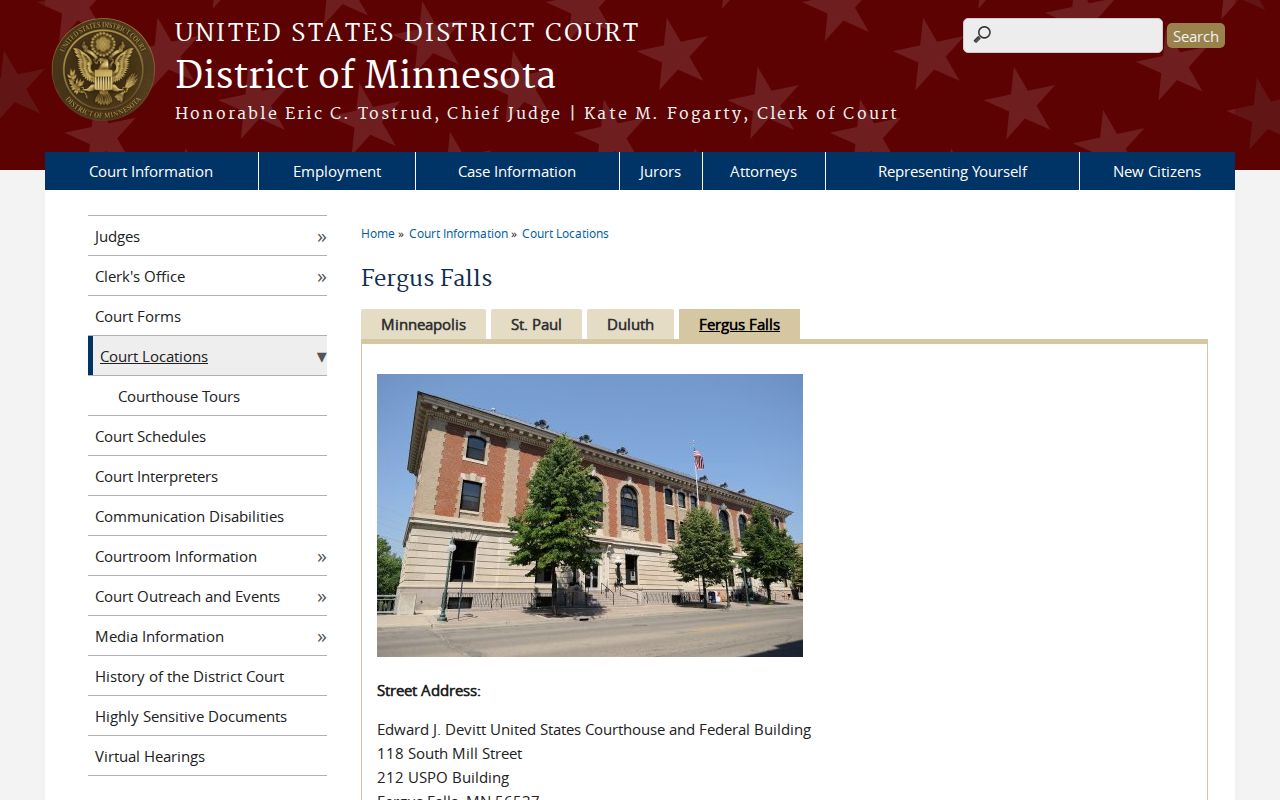
Federal warrants stay inside the federal system, so no Clay County warrant search will ever list them.
If You Think You Are on a List
Get the facts first. The Clay County court alone can say whether an order is open, and the sheriff explains how service works. A lawyer can explain what it means for you.
Important: Do not contact anyone who posted your name, and do not ask a private website to remove a record. Talk to the court and an attorney first.
A name on an unofficial Clay County page can be wrong, outdated, or tied to the wrong person. Only the court can confirm where you stand.
Unofficial Clay County Most Wanted Lists
Start with the record, not the website. Ask Clay County District Court Administration whether a case exists and whether an order is open. If one does, the next step is a lawyer. Minnesota's data practices law binds government agencies, not private publishers, so a Chapter 13 request will not reach a private page. Misused information is a different problem. A lawyer can lay out the options that apply to the publisher. Court confirmation in Clay County still settles where you stand. Note: Unofficial warrant pages are often built from stale data and should never be treated as a court record.