
Clay County Bench Warrants Explained
Most people say bench warrant. Minnesota records rarely do. A file will usually call it a failure-to-appear warrant, or an order issued after a missed appearance, and a judge in an open Clay County case signs it either way. The name does not change what follows. The order stays active until it is served or recalled by the judge who issued it. Clay County publishes no bench-warrant list, so the answer lives in the case record itself, and that record is what you need to pull.
Missed Clay County Court Dates and Bench Warrants
The path is short. A case opens, an appearance is required, the person does not show, and the court responds with an order. In a Clay County file, that sequence shows up in the Register of Actions as a missed-appearance event followed by an order entry.
Warrant flow: Case filed › hearing set › appearance missed › failure-to-appear order issued › served or recalled › case resumes
A missed date does not guarantee a warrant, though. The judge weighs the reason for the absence, whether notice was given, and whether a sign-and-release order could accomplish the same thing in Clay County court.
How Clay County Bench Warrants Are Issued
The order starts with the judge on the case, who signs it and puts it in the file. Rule 3.02 sets the contents: the warrant must identify the person, describe the offense, and state any bail or conditions. The same rules also require that a person arrested on the order be brought before the issuing court promptly, with a 36-hour outer limit when the court is not in session. Nothing about this runs through a city office. Even when one of the county's cities prosecutes an ordinance matter, the case still reaches Clay County District Court, and the judge there issues whatever order follows a missed appearance. That is where the paper lives.
Clay County Bench Warrants and Sign-and-Release
Minnesota judges have a middle option that many people have never heard of. It is called a sign-and-release warrant. Under Minn. Stat. §629.415, it directs a person to appear without authorizing an arrest, and it does not require bail on its own. The statute also makes the sheriff and the court notify officers, provide the new hearing date, and inactivate the order once it is executed. The practical gap between the two orders is wide. An ordinary failure-to-appear warrant puts a person at real risk of arrest, while a sign-and-release order mostly just puts a court date back on the calendar in Clay County. Either way, the underlying case keeps moving, and missing the new date leads straight back to the same question.
Bench Warrants and Arrest Warrants Compared
Both orders come from the same court on the same case file. They act on liberty in different ways. The table compares the orders a Clay County file is most likely to show.
| Order | What Triggered It | What It Allows |
|---|---|---|
| Arrest warrant | Probable cause on a filed complaint | Taking the person into custody |
| Failure-to-appear warrant | A missed court appearance | Custody, with bail or conditions set by the judge |
| Sign-and-release warrant | A missed appearance or a notice problem | A new appearance date, with no arrest authority |
What a Clay County Warrant Flag Misses
The warrant flag is a portal indicator, and that is all it is. It does not name the order or say what triggered it. The state's own guidance warns it can belong to a different case for the same person. A Clay County file may also carry an order the public portal never shows, since pending matters and some documents stay out of remote view. Reading the case details settles the question. Open the case, work through the Register of Actions, and call Clay County District Court Administration if the entry is still unclear.
Resolving a Clay County Bench Warrant
Resolution runs through the issuing court, not the sheriff. The choices are a voluntary appearance, a bail posting, or a motion asking the judge to recall or quash the order. An attorney can tell a Clay County defendant which fits and can file the motion.
Caution: A bench warrant stays active until the judge recalls it. Missing a second court date makes the next order harder to resolve.
A sign-and-release order still requires an appearance. Bail can be posted at any Minnesota county before an arrest on a Clay County warrant, and Clay County sets the date. The county also adds a $50 warrant fee whenever it issues a warrant, which is why an unpaid-fine bail amount can run higher than the fine itself. The resolving steps sit on the Clay County warrant records home page.
Clay County Bench Warrants After Missed Court
Act the same week. A short delay is easier to explain to a Clay County judge than a long one, and the court can only work with what it knows.
- Open the case in the state portal and read the Register of Actions.
- Call Clay County District Court Administration at 218-227-7040 with the case number.
- Ask what the order requires and whether a new appearance can be scheduled.
- Talk to an attorney before appearing or posting bail.
- Follow the court's instructions on bail, conditions, or a recall motion.
Note: The court calendar can be checked for the next hearing, but it excludes confidential cases and does not replace the Clay County court's own answer.
Finding the Court That Issued the Warrant
Most Clay County orders trace to one office. That is Clay County District Court Administration. It sits at 807 N. 11th Street in Moorhead, 218-227-7040, under court administrator Renelle Fenno. Her office keeps the file, the calendar, and every certified copy of an order. Service and custody questions go elsewhere. The sheriff's Warrant and Transport Unit, 218-299-7576, answers whether a person is in custody, how service works, and what happens on transport. Civil Process and Court Security handle unrelated work. Their numbers are 218-299-5106 and 218-299-5064. The county's Support Services page lists the warrant unit alongside civil process and court security.
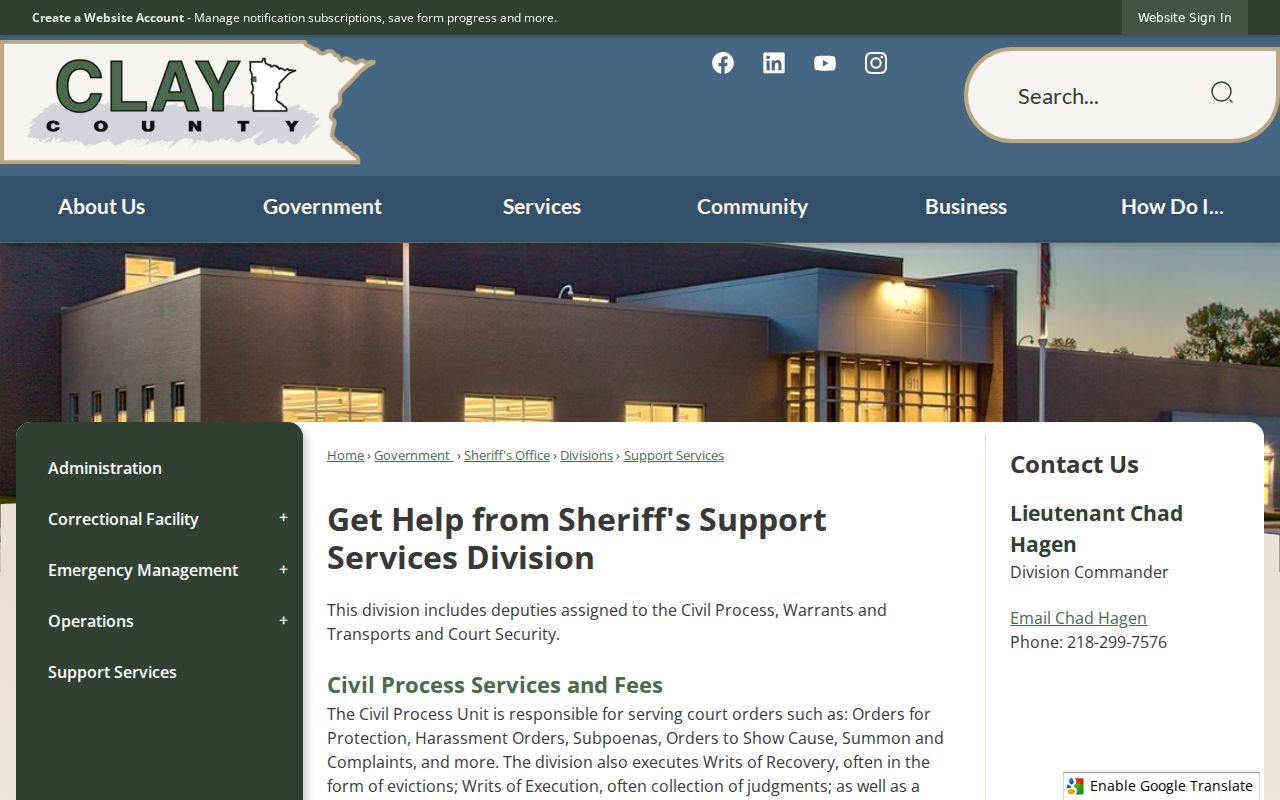
The warrant unit answers custody and service questions in Clay County; the court itself answers anything about the order.
Clay County Bench Warrant Timelines
Clay County bench warrant timelines can shift when the underlying failure-to-appear charge goes away. Two statutes carve out narrow paths. Minn. Stat. §609.49 covers qualifying felony failure-to-appear charges. Dismissal follows if the person voluntarily appears within 48 hours, subject to the conditions written into the statute. Minn. Stat. §609.491 sets a different rule for petty misdemeanors. There, the charge can be dismissed if the person appears within 10 days, unless contrary circumstances exist. Neither rule recalls a Clay County warrant on its own, and neither one fits every case. The issuing court still has to act, which is why a call to Clay County District Court Administration comes before anything else.